


Adobe Commerce SaaS: How Will It Empower Your eCommerce Business?
22 Apr 2025
 Mike Patel

Adobe announced the launch of the Adobe Commerce SaaS (Software-as-a-Service) version at the Adobe Summit 2025 in Las Vegas. The platform will be available for users in June 2025. Since the announcement, the news has captured the spotlight across LinkedIn and the eCommerce community.
However, merchants with Adobe Commerce on-premise, Adobe PaaS Cloud, or Magento Open Source solutions feel excitement, curiosity, and concern. Companies are worried about how the new Adobe version impacts their existing setups and what changes lie ahead. On the other hand, Magento users fear that the platform may be overlooked.
This post will address your concerns by sharing key capabilities, challenges, differences, and benefits of the upcoming Adobe SaaS.
Let’s explore what to expect from Adobe Commerce SaaS!
Adobe Commerce Suite – A Quick Overview
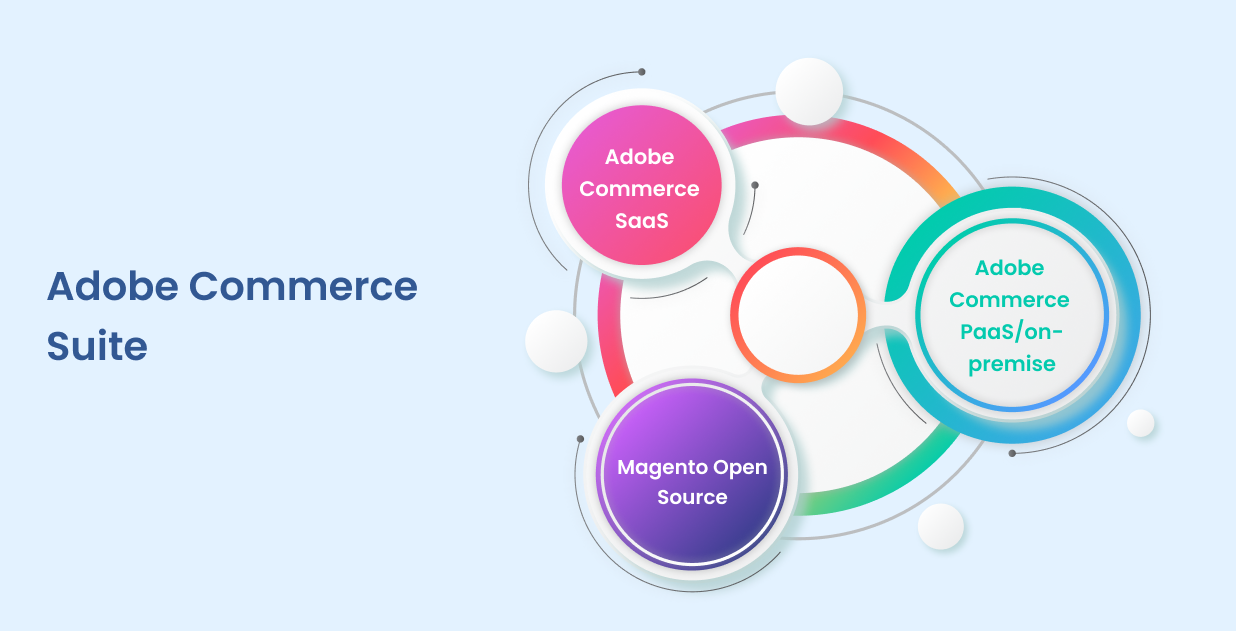
Adobe Commerce SaaS
Adobe SaaS is a fully managed, cloud-based eCommerce solution. It is also popularly known as Adobe Commerce Cloud Services (ACCS). The platform is expected to simplify operations, improve scalability, and reduce the overhead cost of infrastructure management.
Adobe Commerce PaaS/On-Premise
It’s a traditional model in which the eCommerce solution is hosted in Adobe’s cloud or by a third-party provider. Adobe Commerce PaaS/On-Premise comes with more control and responsibilities.
Magento Open Source
Magento Open Source will continue to be a free and self-hosted version supported by the community and third-party providers.
Top Concerns of Merchants for Adopting Adobe SaaS
Shifting to SaaS will be a strategic move for organizations that want scalability and simplicity for their dynamic eCommerce solutions. As Adobe hasn’t released a detailed roadmap yet, multiple questions are on the minds of merchants, including
- What will happen to existing customers?
- Will Adobe continue to support and invest in the PaaS/on-premise model?
- What is the long-term future of Magento Open Source?
- How easy (and costly) will it be for current users to migrate to SaaS?
Adoption of Adobe Commerce SaaS will be a game-changer for your eCommerce strategy. Introducing advanced capabilities, Adobe is gearing up to gain a competitive edge over leading eCommerce platforms such as BigCommerce, Shopify, WooCommerce, and more.
Companies should stay informed, updated, and proactive in learning and adapting Adobe SaaS to stay ahead of the market shift.
Values to Expect from Adobe Commerce SaaS
Adobe SaaS provides users with a streamlined and fully managed experience. It empowers merchants by
- Reducing time spent on infrastructure and security management
- Scaling operations easily during peak seasons
- Offering AI-powered personalization
- Providing Lower Total Cost of Ownership (TCO)
- Optimizing performance and improving page loading
- Focusing on business growth rather than backend maintenance
Key Offerings of Adobe Commerce SaaS Platform
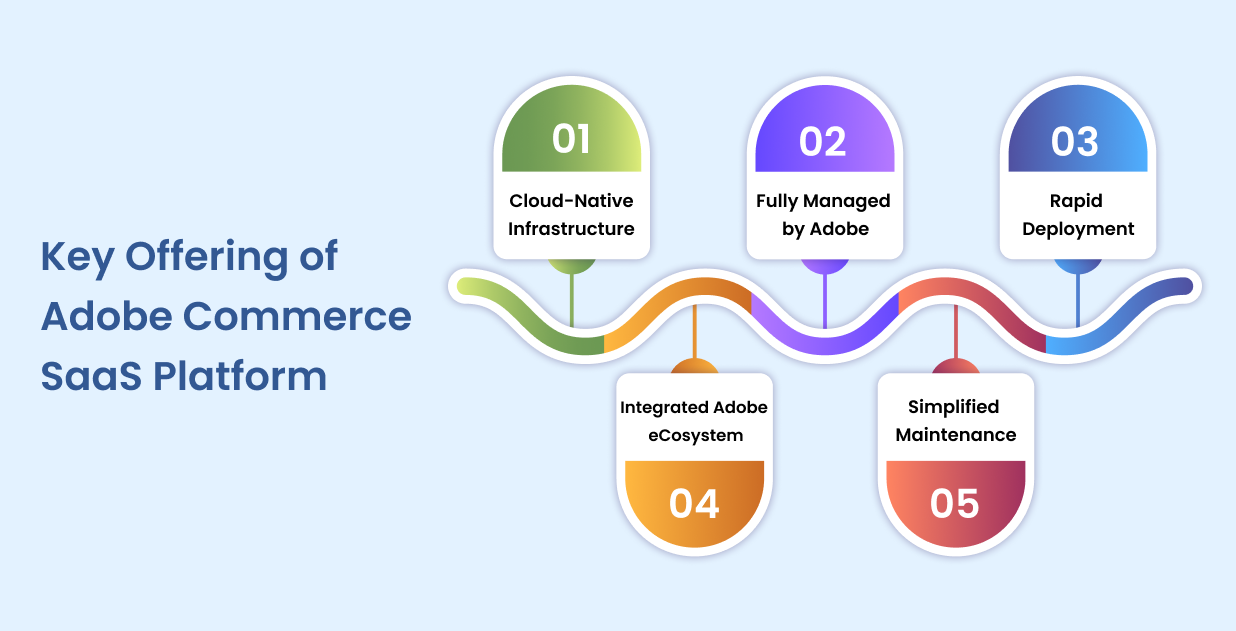
Cloud-Native Infrastructure
Built on Adobe’s enterprise-grade cloud infrastructure, it enhances scalability and availability.
Fully Managed by Adobe
Say goodbye to infrastructure overhead costs. Adobe manages everything for you, including hosting, upgrades, security patches, and performance optimization.
Rapid Deployment
SaaS accelerates deployment cycles with pre-built capabilities and continuous updates. With Adobe’s pre-built components, you can leverage rapid solution deployment with minimal setup.
Integrated Adobe Ecosystem
Seamless connections with Adobe Experience Cloud, analytics, and personalization tools.
Simplified Maintenance
No more manual upgrades or patching. Now, the updates will be automatic and non-disruptive.
Adobe Commerce SaaS vs Adobe Commerce PaaS/On-Prem vs Magento Open Source: A Tabular Comparison

Will Adobe SaaS Affect Adobe Commerce PaaS/On-Premise and Magento Open Source Customers?
No. The tech giant will fully support Adobe Commerce On-Premise, Adobe PaaS, and Magento Open Source.
Key Features of Adobe Commerce SaaS/Adobe Commerce Cloud Services (ACCS)
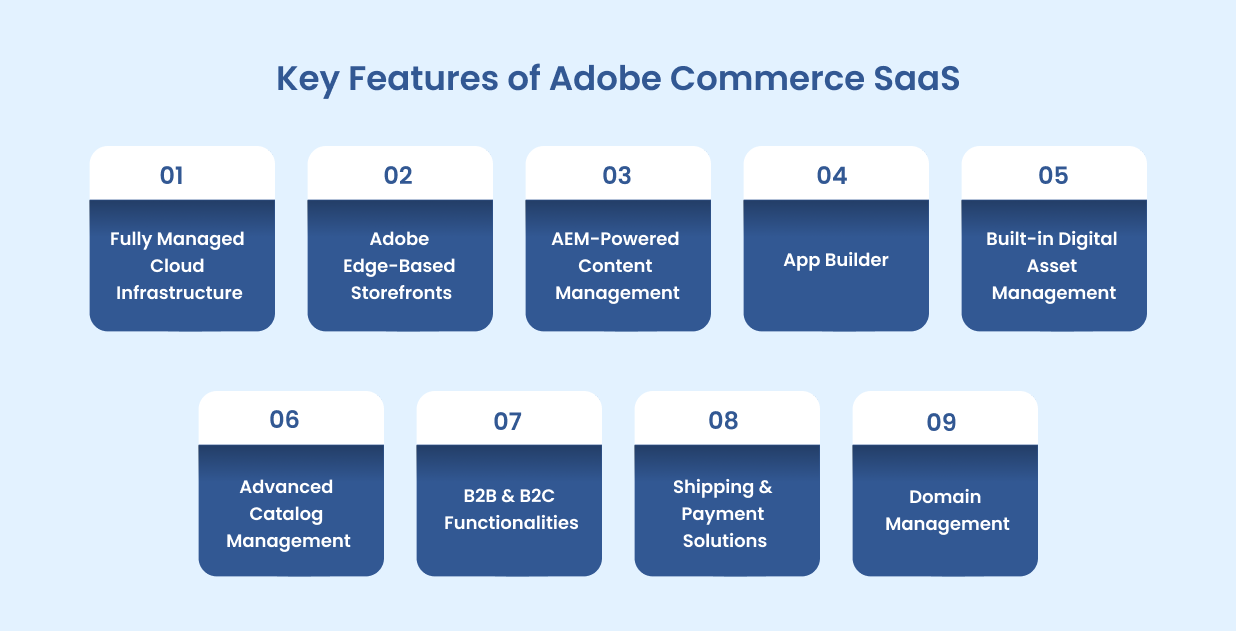
1. Fully Managed Cloud Infrastructure
Adobe Commerce SaaS is built on a robust cloud architecture hosted on Amazon Web Services (AWS). Now, Adobe will handle hosting, server management, and infrastructure operations. Merchants will be free from these responsibilities.
2. Adobe Edge-Based Storefronts
Adobe Commerce SaaS will contain Adobe Edge Delivery Services, which allow brands to create modern storefronts with high-performance infrastructure. Build a user interface designed to achieve speed, scalability, and responsiveness.
3. AEM-Powered Content Management
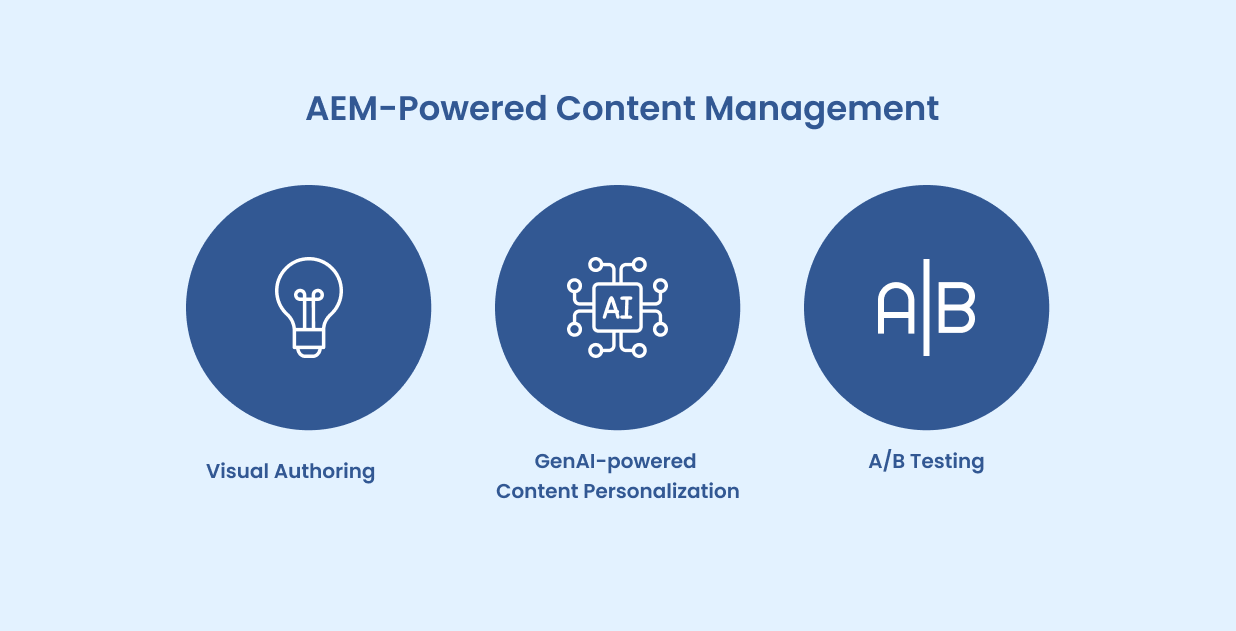
Visual Authoring
It is a universal editor by Adobe Experience Cloud in ACCS. It will consist of WYSIWYG capabilities that allow marketers, developers, and merchandisers to build their own builders for easy content management. Visual Authoring will let users create their own functionality, associate it with an icon, and use it in the visual editor with native functionalities.
GenAI-powered Content Personalization
Adobe SaaS will consist of built-in GenAI for content personalization and AI-powered image creation capabilities.
GenAI enables organizations to create audience-specific content variations using pre-defined templates. Businesses can deliver hyper-personalization by leveraging AI-generated text, images, and product recommendations.
Merchants will need to enter a natural language prompt in Firefly and Adobe Express. The AI-powered tools will generate product descriptions, marketing copies, and visuals instantly. The tools will ensure a fast and consistent content creation process for promotions, seasonal campaigns, or vast product catalogs.
A/B Testing
Every merchant considers A/B testing to achieve better results. However, it becomes tedious when you rely on third-party platforms.
Adobe SaaS will allow you to test content variations from the same interface. You will be able to test content variants based on devices, locations, audiences, and more. It will help you explore options to split traffic based on their preferences.
4. App Builder
Adobe Commerce SaaS will contain an app builder that helps businesses extend their store functionality using APIs and microservices. App Builder will no longer require modifications in Magento’s core.
Businesses will be able to add features, automate workflows, or integrate with third-party apps without the risk of breaking core updates. Whether you want to create custom functionality for your store, simplify backend operations, or improve customers’ shopping experiences, the App Builder will help you attain it.
Applications from App Builder will run outside of Magento’s core database, which will provide long-term stability, faster deployments, and better scaling.
5. Built-In Digital Asset Management
Smart Imaging
Smart imaging will automatically optimize your images based on device type, screen resolution, and network speed. It will ensure faster image loading time without compromising on quality.
Dynamic Media
Harnessing the potential of dynamic media, you will create rich and interactive visuals, such as zoomable images, 360-degree product views, and adaptive videos that enhance customer engagement.
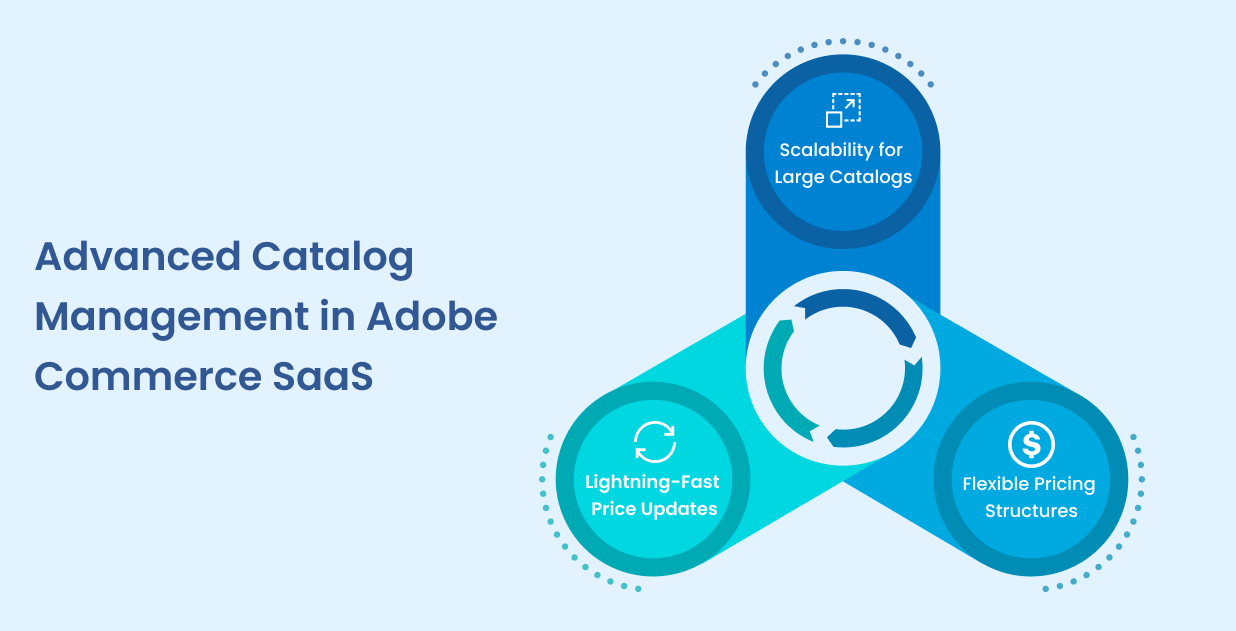
6. Advanced Catalog Management
With Adobe Commerce as a Cloud Service (ACCS), you will manage complex product catalogs more easily and efficiently.
Scalability for Large Catalogs
ACCS will support up to 250 million SKUs in a single catalog. Thus, it will be the best choice for enterprises that manage vast product inventories across multiple storefronts.
Flexible Pricing Structures
Businesses will be able to define up to 30,000 unique price points per SKU. It will help merchants to create more granular pricing strategies for different customer segments, locations, and promotions.
Lightning-Fast Price Updates
Earlier, launching a price promotion for 2 million SKUs took weeks. Now, Adobe SaaS will do it in just 1 hour. This rapid execution will empower brands to respond quickly to market demands, seasonal campaigns, and competitive pricing adjustments.
7. B2B & B2C Functionalities
Adobe Commerce Cloud Services will bring a suite of built-in B2B & B2C features to empower the existing capabilities.
Usually, companies need to invest heavily in custom development, integrations, infrastructure management, and other tech activities. ACCS will provide all these as built-in functionalities, which save time and money for exploring and investing in different platforms.
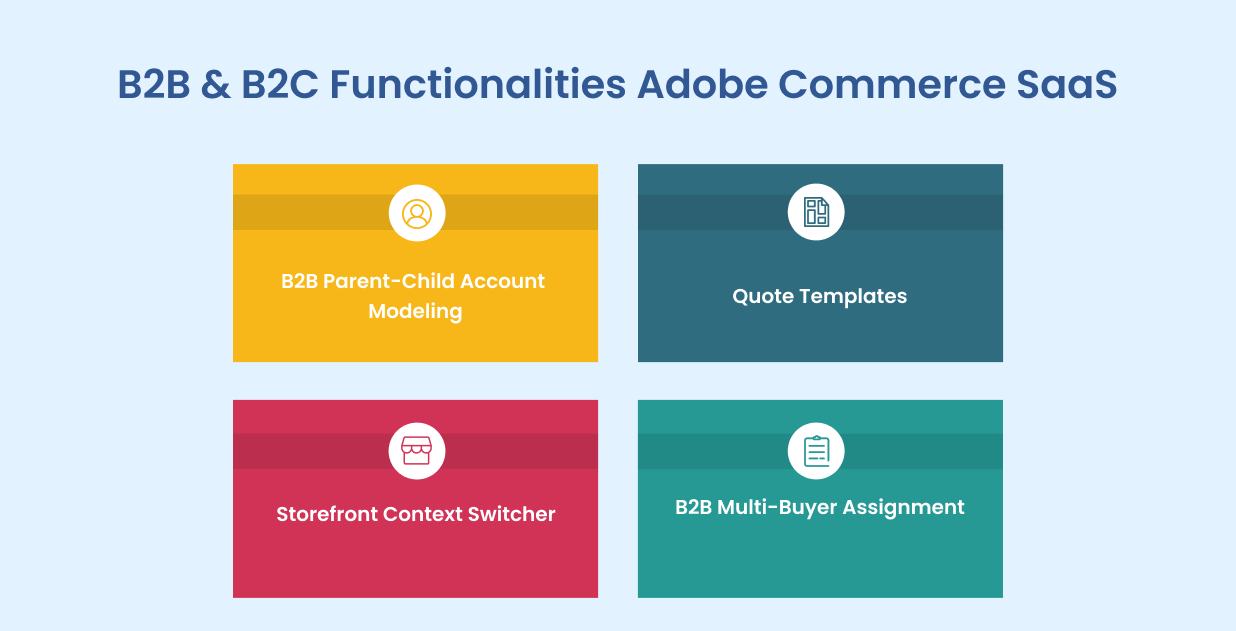
Here are the B2B capabilities in Adobe Commerce Cloud Services (ACCS):
B2B Parent-Child Account Modeling
This model will support hierarchical business structures with parent companies, divisions, buying teams, and users. It will allow merchants to define shared pricing rules and contract pricing.
Quote Templates (Standing Quotes)
Using standing quotes, businesses will create and manage quote templates for faster and standardized negotiations.
B2B Multi-Buyer Assignment
This feature will support multiple buyers per company with flexible role assignments.
Storefront Context Switcher
ACCS will allow merchants to manage multiple businesses by switching between storefronts with price and catalog variations quickly.
8. Shipping & Payment Solutions
Adobe Commerce SaaS will offer built-in shipping and payment integrations.
Merchants will be able to connect with leading payment gateways like PayPal, Stripe, and Authorize.net without complex configurations.
Additionally, shipping options will be fully customizable, allowing businesses to set flexible shipping rates, offer real-time carrier calculations, and support international shipping.
9. Domain Management
Unlike other SaaS solutions, Adobe SaaS will allow easy domain integration and management with a few clicks. The cloud-based system allows businesses to connect, manage, and switch domains effortlessly.
Benefits of Adobe Commerce SaaS
- Reduced Maintenance and Development Costs
- No More Manual Version Upgrades
- Easy Store Maintenance
- Enterprise-Grade Security
- No More Magento Performance Issues
- A Complete Headless Setup
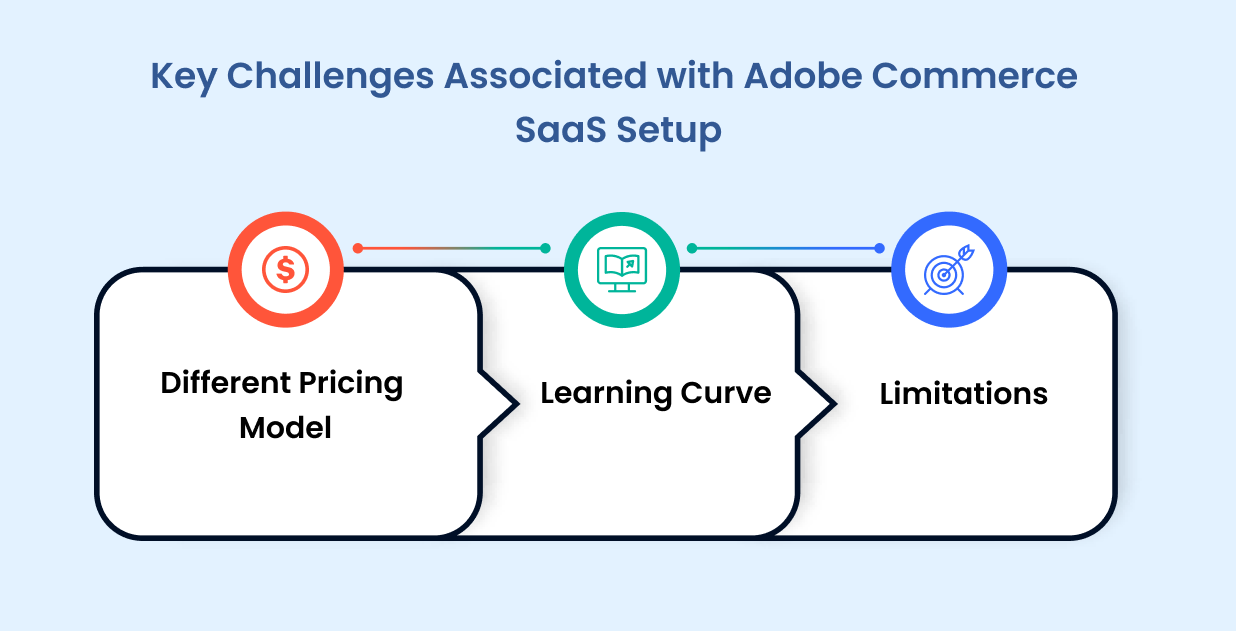
Key Challenges Associated with Adobe Commerce SaaS Setup
1. Different Pricing Model
As you already know, Magento Open Source is free to use, and Adobe Commerce operates on a custom pricing model where the costs vary based on business size and revenue.
The Adobe SaaS setup will follow a subscription-based pricing model, where the costs will be predictable.
But again, it won’t be budget-friendly for all businesses.
For now, pricing details for the SaaS platform haven’t been disclosed by Adobe. However, it is understood that the cost structure is influenced by various factors such as Gross Merchandise Value (GMV), Average Order Value (AOV), and specific business requirements.
2. Learning Curve
Every new technology comes with a learning curve. It applies to Adobe Commerce SaaS solutions, too.
Though the platforms will bring ease to your eCommerce operations, there will be a learning curve where merchants need time to learn about
- Features and functionality of the platform
- Understand the admin panel
- How to manage multiple storefronts efficiently, and more
When switching to Adobe Commerce SaaS (ACCS), businesses may need to invest time and effort in training their employees to use the platform effectively.
3. Limitations
Adobe Commerce as Cloud Services is designed to provide a scalable and managed environment. In self-hosted versions of Magento, merchants and developers had the flexibility to make changes to the server infrastructure.
However, ACCS won’t allow you to make such changes. It will have certain limitations when it comes to deep customizations. It may not provide as much flexibility as traditional Magento.
Limited access to core files will restrict developers from making extensive modifications. Additionally, merchants will depend on Adobe’s platform updates and maintenance releases. This means they need to wait for scheduled releases.
ioVista – An Early Adopter of the Adobe Commerce SaaS Platform
Being a certified partner of Adobe, ioVista has early access to all the latest updates, releases, and launches of Adobe. We have a team of Adobe Commerce experts trained by the Adobe team.
ioVista, a leading Adobe Commerce agency, has a proven track record of delivering robust and tailored solutions. Having expertise in Adobe Commerce development, integration, migration, and re-platforming services, we help brands build an eCommerce platform that improves operational efficiency and increases customer engagement.
If you are excited to adopt the upcoming Adobe Commerce SaaS platform to transform the way your eCommerce ecosystem works, talk to our experts to build cutting-edge Adobe Commerce solutions.
Mike Patel

Mike Patel is the Founder and CEO of ioVista, a leading digital commerce agency specializing in eCommerce solutions. With a strong background in business and technology, Mike Patel has been at the forefront of driving digital transformations for businesses. He has successfully navigated the ever-changing landscape of eCommerce, helping companies leverage the power of online platforms to grow their brand, increase revenues, and optimize their digital presence. Under his leadership, ioVista has become a trusted partner with major technology companies: Adobe/Magento, Google, BigCommerce, Shopify, and Yahoo. He is dedicated to staying ahead of industry trends, adopting cutting-edge technologies, and continuously improving strategies to provide clients with a competitive edge. Mike’s commitment to excellence and client satisfaction is evident in every project ioVista undertakes.
Popular Posts
-
 Adobe Commerce, E-Commerce, Migration, News, Web Development
Adobe Commerce Security Update APSB25-50: Key Highlights
Mike Patel
11 Jun 2025 -
 Adobe Commerce, E-Commerce, Migration, News, Web Development
B2B Excellence Starts with Adobe Commerce (Magento) - Not WooCommerce
Mike Patel
03 Jun 2025 -
 Adobe Commerce, E-Commerce, Migration, News, Web Development
AI and ML in B2B: A Vision for the Future of Commerce by 2025
Mike Patel
27 May 2025 -
 Adobe Commerce, E-Commerce, Migration, News, Web Development
20 Next-Gen B2B eCommerce Features that will Dominate in 2025
Mike Patel
20 May 2025 -
 Adobe Commerce, E-Commerce, Migration, News, Web Development
WooCommerce to BigCommerce Migration Fuels Your B2B eCommerce Growth
Mike Patel
06 May 2025 -
 Adobe Commerce, E-Commerce, Migration, News, Web Development
Adobe Commerce SaaS: How Will It Empower Your eCommerce Business?
Mike Patel
22 Apr 2025 -
 Adobe Commerce, E-Commerce, Migration, News, Web Development
Leverage ERP Integration to Scale Your B2B eCommerce Business in 2025
Mike Patel
15 Apr 2025 -
 Adobe Commerce, E-Commerce, Migration, News, Web Development
Adobe Commerce Security Update APSB25-26: All You Need to Know
Mike Patel
10 Apr 2025 -
 Adobe Commerce, E-Commerce, Migration, News, Web Development
Adobe Commerce 2.4.8 Release: Key Highlights
Mike Patel
10 Apr 2025 -
 Adobe Commerce, E-Commerce, Migration, News, Web Development
Why Scaling Business Should Migrate WooCommerce Stores to Shopify
Mike Patel
08 Apr 2025 -
 Adobe Commerce, E-Commerce, Migration, News, Web Development
Why Does Adobe Commerce (Magento) Lead the Way of B2B eCommerce
Mike Patel
18 Mar 2025 -
 Adobe Commerce, E-Commerce, Migration, News, Web Development
10 Key Drivers of Digital Transformation in B2B eCommerce for 2025
Mike Patel
04 Mar 2025 -
 Adobe Commerce, E-Commerce, Migration, News, Web Development
5 Leading eCommerce Platforms to Build Scalable B2B Customer Portals
Mike Patel
25 Feb 2025 -
 Adobe Commerce, E-Commerce, Migration, News, Web Development
Google Search Ranking Volatility: All You Need to Know
Mike Patel
18 Feb 2025 -
 Adobe Commerce, E-Commerce, Migration, News, Web Development
Adobe Commerce Security Update APSB25-08: All You Need to Know
Mike Patel
13 Feb 2025 -
 Adobe Commerce, E-Commerce, Migration, News, Web Development
7 Strategic Benefits of an Online B2B Customer Portal
Mike Patel
11 Feb 2025 -
 Adobe Commerce, E-Commerce, Migration, News, Web Development
What Makes a Great Online B2B Customer Portal? Top 10 Features to Know
Mike Patel
04 Feb 2025 -
 Adobe Commerce, E-Commerce, Migration, News, Web Development
Legacy B2B eCommerce Systems Slowing You Down? It's Time for Modernization
Mike Patel
28 Jan 2025 -
 Adobe Commerce, E-Commerce, Migration, News, Web Development
Essential B2B Commerce Features for 2024
Mike Patel
20 Nov 2024 -
 Adobe Commerce, E-Commerce, Migration, News, Web Development
Security Update Available for Adobe Commerce | APSB24-90
Mike Patel
20 Nov 2024 -
 Adobe Commerce, E-Commerce, Migration, News, Web Development
Why Choose Hyvä Enterprise for Your Adobe Commerce Store?
Mike Patel
19 Nov 2024 -
 Adobe Commerce, E-Commerce, Migration, News, Web Development
Security Update APSB24-73 for Adobe Commerce: Everything You Need to Know
Mike Patel
14 Oct 2024 -
 Adobe Commerce, E-Commerce, Migration, News, Web Development
CosmicSting Exploit Still Poses a Threat
Mike Patel
25 Jul 2024 -
 Adobe Commerce, E-Commerce, Migration, News, Web Development
CosmicSting: Unauthorized XXE Vulnerability
Mike Patel
17 Jul 2024 -
 Adobe Commerce, E-Commerce, Migration, News, Web Development
Hyvä Theme for Magento 2: Uncover Powerful Features – Evaluate Pros and Cons
Mike Patel
16 Jul 2024 -
 Adobe Commerce, E-Commerce, Migration, News, Web Development
Magento 2.4.7: Explore the Newest Enhancements and Features
Mike Patel
30 Apr 2024 -
 Adobe Commerce, E-Commerce, Migration, News, Web Development
Magento 2.4.6-p5: Enhancing Stability and Security
Mike Patel
22 Apr 2024 -
 Adobe Commerce, E-Commerce, Migration, News, Web Development
Everything You Need To Know About eCommerce SEO in 2024
Mike Patel
16 Apr 2024 -
 Adobe Commerce, E-Commerce, Migration, News, Web Development
The Impact of Site Speed on eCommerce SEO Performance
Mike Patel
14 Feb 2024 -
 Adobe Commerce, E-Commerce, Migration, News, Web Development
ioVista Attains B2B Specialization on BigCommerce
Mike Patel
30 Oct 2023 -
 Adobe Commerce, E-Commerce, Migration, News, Web Development
5 Ways to Boost eCommerce Sales in 2024
Mike Patel
21 Sep 2023 -
 Adobe Commerce, E-Commerce, Migration, News, Web Development
It’s Official: ioVista Has Become a Recognized Adobe Specialized Partner
Mike Patel
05 Sep 2023 -
 Adobe Commerce, E-Commerce, Migration, News, Web Development
Magento 2.4.7-beta1 Release
Mike Patel
15 Aug 2023 -
 Adobe Commerce, E-Commerce, Migration, News, Web Development
Why Are You Still Using Yahoo Stores in 2023?
Mike Patel
05 Jul 2023 -
 Adobe Commerce, E-Commerce, Migration, News, Web Development
ioVista Announced as a 2023 Local Excellence Award Winner by UpCity
Mike Patel
09 May 2023 -
 Adobe Commerce, E-Commerce, Migration, News, Web Development
Google Analytics 4: What You Need To Know
Mike Patel
29 Mar 2023 -
 Adobe Commerce, E-Commerce, Migration, News, Web Development
Adobe Commerce 2.4.6 Release
Mike Patel
13 Mar 2023 -
 Adobe Commerce, E-Commerce, Migration, News, Web Development
Questions You Should Ask Your Magento Agency
Mike Patel
17 Feb 2023 -
 Adobe Commerce, E-Commerce, Migration, News, Web Development
7 Proven Strategies to Increase B2B/Wholesale eCommerce Revenue
Mike Patel
01 Feb 2023 -
 Adobe Commerce, E-Commerce, Migration, News, Web Development
10 eCommerce Trends to Increase your Sales in 2023
Mike Patel
12 Jan 2023 -
 Adobe Commerce, E-Commerce, Migration, News, Web Development
B2B eCommerce Features Your Store Need in 2023
Mike Patel
05 Jan 2023 -
 Adobe Commerce, E-Commerce, Migration, News, Web Development
Adobe/Magento Highlights 2022 - Is your store Up-to-Date
Mike Patel
20 Dec 2022 -
 Adobe Commerce, E-Commerce, Migration, News, Web Development
Adobe discontinues Support for the 2.4.0-2.4.3 Release Line
Mike Patel
09 Dec 2022 -
 Adobe Commerce, E-Commerce, Migration, News, Web Development
BFCM Round-Up – Get Your Store Ready for Christmas 2022!
Mike Patel
07 Dec 2022 -
 Adobe Commerce, E-Commerce, Migration, News, Web Development
Universal Analytics Going Away: What Does it Mean, What you need to Do?
Mike Patel
24 Nov 2022 -
 Adobe Commerce, E-Commerce, Migration, News, Web Development
40% of Magento and Adobe Commerce Websites at Risk in November 2022
Mike Patel
17 Nov 2022 -
 Adobe Commerce, E-Commerce, Migration, News, Web Development
ioVista Awarded the Best B2B Company 2022
Mike Patel
04 Nov 2022 -
 Adobe Commerce, E-Commerce, Migration, News, Web Development
Adobe Releases Critical Security Patches for Magento 2.4.5 and 2.4.4
Mike Patel
27 Oct 2022 -
 Adobe Commerce, E-Commerce, Migration, News, Web Development
Holiday Season Best Practices for eCommerce
Mike Patel
20 Oct 2022 -
 Adobe Commerce, E-Commerce, Migration, News, Web Development
ioVista is Sponsoring the Largest eCommerce Event in Dallas
Mike Patel
07 Oct 2022 -
 Adobe Commerce, E-Commerce, Migration, News, Web Development
Magento 2 Vulnerability: Surge in Hacking on Unpatched Stores
Mike Patel
27 Sep 2022 -
 Adobe Commerce, E-Commerce, Migration, News, Web Development
Get your Holiday eCommerce Marketing Started with These 5 Tips
Mike Patel
15 Sep 2022 -
 Adobe Commerce, E-Commerce, Migration, News, Web Development
Why a Magento Code Audit is Essential for your eCommerce Store
Mike Patel
10 Sep 2022 -
 Adobe Commerce, E-Commerce, Migration, News, Web Development
Launching a Successful eCommerce Store
Mike Patel
30 Aug 2022 -
 Adobe Commerce, E-Commerce, Migration, News, Web Development
Choosing the Right eCommerce Platform for B2B
Mike Patel
25 Aug 2022 -
 Adobe Commerce, E-Commerce, Migration, News, Web Development
The Challenges of eCommerce in Manufacturing and how to Overcome them
Mike Patel
17 Aug 2022 -
 Adobe Commerce, E-Commerce, Migration, News, Web Development
Adobe Releases Magento Open Source and Adobe Commerce 2.4.5
Mike Patel
10 Aug 2022 -
 Adobe Commerce, E-Commerce, Migration, News, Web Development
How Manufacturers can Switch to eCommerce
Mike Patel
02 Aug 2022 -
 Adobe Commerce, E-Commerce, Migration, News, Web Development
Benefits of eCommerce for Manufacturing
Mike Patel
25 Jul 2022 -
 Adobe Commerce, E-Commerce, Migration, News, Web Development
Magento 2.3.x End-of-Life in September 2022
Mike Patel
19 Jul 2022 -
 Adobe Commerce, E-Commerce, Migration, News, Web Development
The Growth of eCommerce and its impact on the Manufacturing Industry
Mike Patel
01 Jul 2022 -
 Adobe Commerce, E-Commerce, Migration, News, Web Development
The Future of Manufacturing Business is Digital
Mike Patel
24 Jun 2022 -
 Adobe Commerce, E-Commerce, Migration, News, Web Development
Magento Open Source Vs Commerce Vs Cloud: How to Pick your Edition
Mike Patel
14 Jun 2022 -
 Adobe Commerce, E-Commerce, Migration, News, Web Development
Is your Store Optimized? How do you Measure eCommerce Conversion Rates?
Mike Patel
11 May 2022 -
 Adobe Commerce, E-Commerce, Migration, News, Web Development
ioVista Recognized for B2B Services: Excellence Award Winner 2022
Mike Patel
03 May 2022 -
 Adobe Commerce, E-Commerce, Migration, News, Web Development
How to Optimize Your eCommerce Store for Conversions
Mike Patel
29 Apr 2022 -
 Adobe Commerce, E-Commerce, Migration, News, Web Development
Future Proof your Digital Commerce with Headless Commerce
Mike Patel
21 Apr 2022 -
 Adobe Commerce, E-Commerce, Migration, News, Web Development
Adobe Commerce 2.4.4 Release: Faster, Better, More Scalable
Mike Patel
13 Apr 2022 -
 Adobe Commerce, E-Commerce, Migration, News, Web Development
Is Your Business Ready for Digital Transformation? The Key Steps!
Mike Patel
01 Mar 2022 -
 Adobe Commerce, E-Commerce, Migration, News, Web Development
CVE-2022-24086 What is it?
Mike Patel
16 Feb 2022 -
 Adobe Commerce, E-Commerce, Migration, News, Web Development
February 2022, over 500 Legacy Magento 1 Websites Hacked!
Mike Patel
15 Feb 2022 -
 Adobe Commerce, E-Commerce, Migration, News, Web Development
Adobe released a new End of Support Date for Magento 2.3.x
Mike Patel
04 Feb 2022 -
 Adobe Commerce, E-Commerce, Migration, News, Web Development
The How & Why: Successful Data-Driven Marketing for eCommerce Stores
Mike Patel
13 Jan 2022 -
 Adobe Commerce, E-Commerce, Migration, News, Web Development
How to Find Right Audience for your Online Business
Mike Patel
10 Jan 2022 -
 Adobe Commerce, E-Commerce, Migration, News, Web Development
5 Key Reasons to Enable Social Commerce Channels for your Store
Mike Patel
17 Dec 2021 -
 Adobe Commerce, E-Commerce, Migration, News, Web Development
ioVista is honored to be one of the Top 1000 Companies 2021
Mike Patel
13 Dec 2021 -
 Adobe Commerce, E-Commerce, Migration, News, Web Development
Are Your FB, Instagram, Pinterest Accounts Geared for Social Shopping?
Mike Patel
30 Nov 2021 -
 Adobe Commerce, E-Commerce, Migration, News, Web Development
Five BFCM Strategies Merchants Love To Implement For Holidays
Mike Patel
26 Oct 2021 -
 Adobe Commerce, E-Commerce, Migration, News, Web Development
How to Meet Holiday Shoppers’ Needs With an Omnichannel Approach
Mike Patel
20 Oct 2021 -
 Adobe Commerce, E-Commerce, Migration, News, Web Development
Support for Magento Commerce 2.3 and Magento Open Source 2.3 Ends
Mike Patel
05 Oct 2021 -
 Adobe Commerce, E-Commerce, Migration, News, Web Development
Why your Business Needs Marketing Automation this Holiday Season
Mike Patel
30 Sep 2021 -
 Adobe Commerce, E-Commerce, Migration, News, Web Development
How Augmented Reality can Deliver more Engaging Shopping Experiences
Mike Patel
21 Sep 2021 -
 Adobe Commerce, E-Commerce, Migration, News, Web Development
These 5 Local Business Marketing Strategies Will Transform Your Business
Mike Patel
17 Sep 2021 -
 Adobe Commerce, E-Commerce, Migration, News, Web Development
How eCommerce can be the Game Changer for Warehouses
Mike Patel
08 Sep 2021 -
 Adobe Commerce, E-Commerce, Migration, News, Web Development
Magento 2.4.3 has arrived! Everything you Need to Know
Mike Patel
11 Aug 2021 -
 Adobe Commerce, E-Commerce, Migration, News, Web Development
ioVista named 2021 Top B2B Company in Dallas and Texas
Mike Patel
05 Aug 2021 -
 Adobe Commerce, E-Commerce, Migration, News, Web Development
Why Every Business Should Be on eCommerce
Mike Patel
29 Jul 2021









Let’s work together to create outstanding digital experiences.
With 20+ years of industry experience, ioVista understands your eCommerce needs and delivers best-in-class solutions that help you gain a competitive edge.
or Call us at: +1 214-699-4391

TOP
Get in Touch