


Slow and Steady Wins the Race? Not According to Google.
23 Jun 2014
 Mike Patel


(image source: https://bit.ly/3wlrRUd)
Contrary to the popular adage, “patience is a virtue,” website loading times are an exception to the rule. In today’s fast-paced world, subpar speed just won’t cut it. In order to compete against the big boy browsers within your industry, your site requires a rapid connection to drive leads and conversions.
Let’s face it: no one likes to be kept waiting – especially when it comes to website speed. Think back on how often you’ve groaned in exasperation, waiting for a finicky page to load after a few ticks of the clock’s second hand (no judgment here, we’re just as guilty). The truth is, rapid developments across the tech industry have spoiled consumers rotten. Like Eve to the beckoning apple, consumers have acquired an appetite for instant gratification – and nowadays, lagging websites are guaranteed to leave an aftertaste.
Recent statistics show us that back in 2000, the average attention span of adults waned after 12 seconds. Flash forward to 2013, and us humans sport a whopping 8-second attention span, before moving onto something shiny. All jokes aside, slow loading times are actually no laughing matter. In fact, it can prove downright detrimental to your cause.
How Loading Time Affects Your Bottom Line
Website speed is one of the most important elements that not only impact user experience, but also drives (or discourages) their buying decisions. Though it’s pretty wild to think something as trivial as ‘impatience’ can affect ROIs, it’s important to note that when it comes to consumer engagement, time is always of the essence.
Your website speed plays a crucial role in how consumers respond to your brand. While I hate to be the bearer of bad news here, it doesn’t matter if your site is loaded with killer graphics, or your marketing vision rivals a young Seth Godin. When it comes down to it, the second your website fails to satisfy consumer interest, that startup dream of yours can easily segue towards a financial deficit.
If you think about it, making a name for yourself within this cutthroat cyber world is really no different from the Domino Effect: every strategic move you make impacts the outcome of the whole sequence. With the right positioning, each piece successfully falls in line with the next. However, one wrong calibration and the entire structure falls short. In matters of your online presence, a miscalculation as simple as site lag can cost you much more than revenue loss; it can cost your entire reputation.
Optimization Achieves Ranking
Just a few years back, Google announced on their Webmaster blog just how influential site speed was in relation to website rankings:
“Speeding up websites is important — not just to site owners, but to all Internet users. Faster sites create happy users and we’ve seen in our internal studies that when a site responds slowly, visitors spend less time there.”
Just four years later, optimized websites built for speed are reaping the benefits of a 15 percent increase in traffic across Google, Yahoo! and Bing search engines. On the flip side? Sites that lag by just 1-second have gotten hit with a 7 percent loss in potential conversions! Ouch.
Still not convinced that your loading time has an impact on ROIs? Take some time to mull over these eye-opening facts:
- The 2-Second Rule: 47 percent of consumers expect a web page to load in two seconds or less.
- Jump Ship: 40 percent of consumers will completely abandon a web page if it takes more than three seconds to load.
- Skewed Memory: Online consumers are convinced that loading times are 35 percent longer than they actually are.
- Uneasy Spenders: 44 percent of online shoppers say that slow online transactions make them anxious about the outcome of their purchase.
- Loading-Time Loyalty: 52 percent of online shoppers claim that rapid loading times play an important role in their loyalty to a site.
- Fickle Shoppers: 75 percent of consumers will abandon a page and start shopping on a competitor’s site, rather than waiting out the delay.
- Never Again: 88 percent of online consumers are less likely to return to a site after one bad experience.
- Judgment Call: Nearly 1/2 of online shoppers form a negative opinion of a brand, simply based on slow loading times.
Keeping up with Competitors
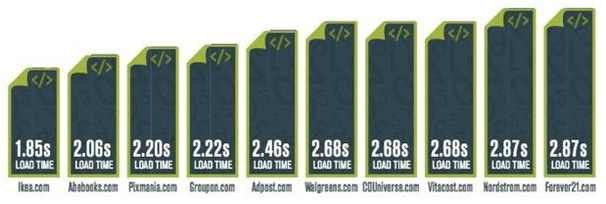
Want to know what lightning-fast looks like? These popular brands have been ranked by Alexa.com as the top 10 retail sites with accelerated loading times. Burning rubber at the #1 spot is Ikea, an impressive victor with a site speed of 1.8 seconds.
(image source: https://bit.ly/3I5t4BN)
Where Would Your Site Rank?
Are loading times slowing your business down? If so, it may be time to revamp your online focus in order to stay afloat in this virtual rat race. Optimize the efficacy of your website; utilize analytic tools to measure loading times, bounce rates and other performance metrics. Once you enhance your site’s speed, you can start to reap the benefits of consumer engagement and conversion rates.
Mike Patel

Mike Patel is the Founder and CEO of ioVista, a leading digital commerce agency specializing in eCommerce solutions. With a strong background in business and technology, Mike Patel has been at the forefront of driving digital transformations for businesses. He has successfully navigated the ever-changing landscape of eCommerce, helping companies leverage the power of online platforms to grow their brand, increase revenues, and optimize their digital presence. Under his leadership, ioVista has become a trusted partner with major technology companies: Adobe/Magento, Google, BigCommerce, Shopify, and Yahoo. He is dedicated to staying ahead of industry trends, adopting cutting-edge technologies, and continuously improving strategies to provide clients with a competitive edge. Mike’s commitment to excellence and client satisfaction is evident in every project ioVista undertakes.
Popular Posts
-

-
 Digital Marketing
B2B Excellence Starts with Adobe Commerce (Magento) - Not WooCommerce
Mike Patel
03 Jun 2025 -
 Digital Marketing
AI and ML in B2B: A Vision for the Future of Commerce by 2025
Mike Patel
27 May 2025 -
 Digital Marketing
20 Next-Gen B2B eCommerce Features that will Dominate in 2025
Mike Patel
20 May 2025 -
 Digital Marketing
WooCommerce to BigCommerce Migration Fuels Your B2B eCommerce Growth
Mike Patel
06 May 2025 -
 Digital Marketing
Adobe Commerce SaaS: How Will It Empower Your eCommerce Business?
Mike Patel
22 Apr 2025 -
 Digital Marketing
Leverage ERP Integration to Scale Your B2B eCommerce Business in 2025
Mike Patel
15 Apr 2025 -
 Digital Marketing
Adobe Commerce Security Update APSB25-26: All You Need to Know
Mike Patel
10 Apr 2025 -
-
 Digital Marketing
Why Scaling Business Should Migrate WooCommerce Stores to Shopify
Mike Patel
08 Apr 2025 -
 Digital Marketing
Why Does Adobe Commerce (Magento) Lead the Way of B2B eCommerce
Mike Patel
18 Mar 2025 -
 Digital Marketing
10 Key Drivers of Digital Transformation in B2B eCommerce for 2025
Mike Patel
04 Mar 2025 -
 Digital Marketing
5 Leading eCommerce Platforms to Build Scalable B2B Customer Portals
Mike Patel
25 Feb 2025 -
-
 Digital Marketing
Adobe Commerce Security Update APSB25-08: All You Need to Know
Mike Patel
13 Feb 2025 -

-
 Digital Marketing
What Makes a Great Online B2B Customer Portal? Top 10 Features to Know
Mike Patel
04 Feb 2025 -
 Digital Marketing
Legacy B2B eCommerce Systems Slowing You Down? It's Time for Modernization
Mike Patel
28 Jan 2025 -
-

-

-
 Digital Marketing
Security Update APSB24-73 for Adobe Commerce: Everything You Need to Know
Mike Patel
14 Oct 2024 -

-

-
 Digital Marketing
Hyvä Theme for Magento 2: Uncover Powerful Features – Evaluate Pros and Cons
Mike Patel
16 Jul 2024 -
 Digital Marketing
Magento 2.4.7: Explore the Newest Enhancements and Features
Mike Patel
30 Apr 2024 -

-
-

-

-
-
 Digital Marketing
It’s Official: ioVista Has Become a Recognized Adobe Specialized Partner
Mike Patel
05 Sep 2023 -
-
-
 Digital Marketing
ioVista Announced as a 2023 Local Excellence Award Winner by UpCity
Mike Patel
09 May 2023 -

-
-

-
 Digital Marketing
7 Proven Strategies to Increase B2B/Wholesale eCommerce Revenue
Mike Patel
01 Feb 2023 -

-
-

-
 Digital Marketing
BigCommerce Releases StagingPro for Enterprise Merchants and Agency Developers
Mike Patel
15 Dec 2022 -
 Digital Marketing
Adobe discontinues Support for the 2.4.0-2.4.3 Release Line
Mike Patel
09 Dec 2022 -

-
 Digital Marketing
Universal Analytics Going Away: What Does it Mean, What you need to Do?
Mike Patel
24 Nov 2022 -
 Digital Marketing
40% of Magento and Adobe Commerce Websites at Risk in November 2022
Mike Patel
17 Nov 2022 -

-
 Digital Marketing
Adobe Releases Critical Security Patches for Magento 2.4.5 and 2.4.4
Mike Patel
27 Oct 2022 -

-
 Digital Marketing
ioVista is Sponsoring the Largest eCommerce Event in Dallas
Mike Patel
07 Oct 2022 -
 Digital Marketing
Magento 2 Vulnerability: Surge in Hacking on Unpatched Stores
Mike Patel
27 Sep 2022 -
 Digital Marketing
Get your Holiday eCommerce Marketing Started with These 5 Tips
Mike Patel
15 Sep 2022 -
 Digital Marketing
Why a Magento Code Audit is Essential for your eCommerce Store
Mike Patel
10 Sep 2022 -

-

-
 Digital Marketing
The Challenges of eCommerce in Manufacturing and how to Overcome them
Mike Patel
17 Aug 2022 -
 Digital Marketing
Adobe Releases Magento Open Source and Adobe Commerce 2.4.5
Mike Patel
10 Aug 2022 -
-

-
-
 Digital Marketing
The Growth of eCommerce and its impact on the Manufacturing Industry
Mike Patel
01 Jul 2022 -

-
 Digital Marketing
Magento Open Source Vs Commerce Vs Cloud: How to Pick your Edition
Mike Patel
14 Jun 2022 -
 Digital Marketing
Is your Store Optimized? How do you Measure eCommerce Conversion Rates?
Mike Patel
11 May 2022 -
 Digital Marketing
ioVista Recognized for B2B Services: Excellence Award Winner 2022
Mike Patel
03 May 2022 -
-

-
 Digital Marketing
Adobe Commerce 2.4.4 Release: Faster, Better, More Scalable
Mike Patel
13 Apr 2022 -
 Digital Marketing
Adobe Commerce and Magento 1 Sites at Risk: Magento Vulnerabilities Exploited
Mike Patel
29 Mar 2022 -
 Digital Marketing
Is Your Business Ready for Digital Transformation? The Key Steps!
Mike Patel
01 Mar 2022 -

-

-
-
 Digital Marketing
The How & Why: Successful Data-Driven Marketing for eCommerce Stores
Mike Patel
13 Jan 2022 -
-
 Digital Marketing
5 Key Reasons to Enable Social Commerce Channels for your Store
Mike Patel
17 Dec 2021 -
 Digital Marketing
ioVista is honored to be one of the Top 1000 Companies 2021
Mike Patel
13 Dec 2021 -
 Digital Marketing
Are Your FB, Instagram, Pinterest Accounts Geared for Social Shopping?
Mike Patel
30 Nov 2021 -
 Digital Marketing
Five BFCM Strategies Merchants Love To Implement For Holidays
Mike Patel
26 Oct 2021 -
 Digital Marketing
How to Meet Holiday Shoppers’ Needs With an Omnichannel Approach
Mike Patel
20 Oct 2021 -
 Digital Marketing
Support for Magento Commerce 2.3 and Magento Open Source 2.3 Ends
Mike Patel
05 Oct 2021 -
 Digital Marketing
Why your Business Needs Marketing Automation this Holiday Season
Mike Patel
30 Sep 2021 -
 Digital Marketing
How Augmented Reality can Deliver more Engaging Shopping Experiences
Mike Patel
21 Sep 2021 -
 Digital Marketing
These 5 Local Business Marketing Strategies Will Transform Your Business
Mike Patel
17 Sep 2021 -

-
-

-









Let’s work together to create outstanding digital experiences.
With 20+ years of industry experience, ioVista understands your eCommerce needs and delivers best-in-class solutions that help you gain a competitive edge.
or Call us at: +1 214-699-4391

TOP
Get in Touch