


80% of B2B Businesses Are Holding You Back by Legacy eCommerce Systems. Is Yours One of Them?
15 Jan 2025
 Mike Patel
Moving on from your existing B2B eCommerce systems will be a difficult decision. After all, you have been using them for a long time. But, if these systems are not contributing to your growth, it’s time to break up.
Legacy systems drain the efficiency of your business operations due to limited scalability, slow performance, lack of customization, poor user experience, and more. Thus, 87% of business leaders said modernization is essential to climb the ladder of success.
Now, a question might hit your mind: how should I know that my existing eCommerce systems are outdated?
Let’s explore the signs that indicate your business needs to adopt modernization.
5 Signs That Indicate Your Existing B2B eCommerce Systems are Outdated
Every B2B eCommerce company encounters a situation where they have to analyze the performance of existing systems in terms of cost, investment, and benefits. If the current systems are holding you back from growing, you need to consider replacing the existing ones with the right ones.
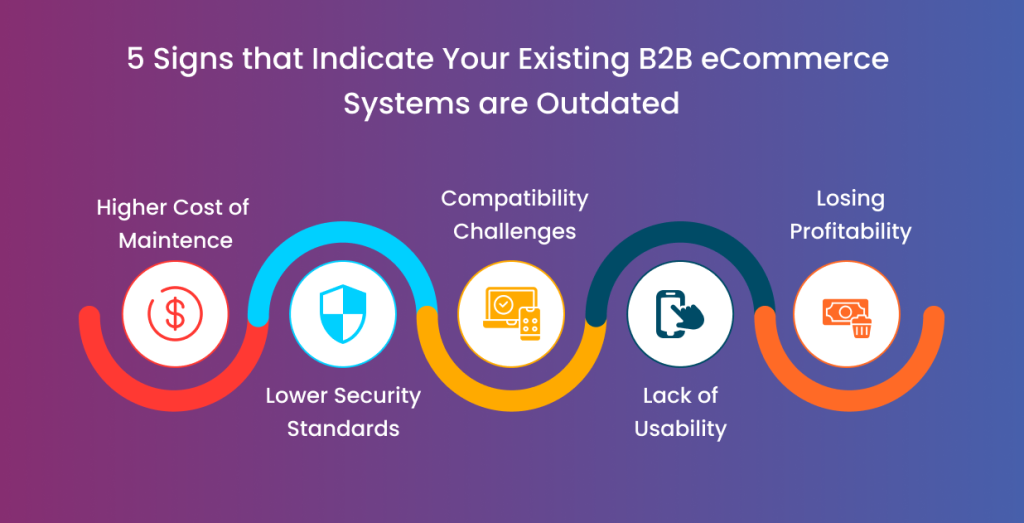
Let’s understand the drawbacks of legacy eCommerce systems.
1. Higher Cost of Maintenance
Innovation and updates in certain technology platforms slow down over time, significantly increasing the maintenance cost of eCommerce systems.
- IT decision-makers predicted allocating an average budget of $2.7 million to address the high maintenance costs of legacy systems in 2024.
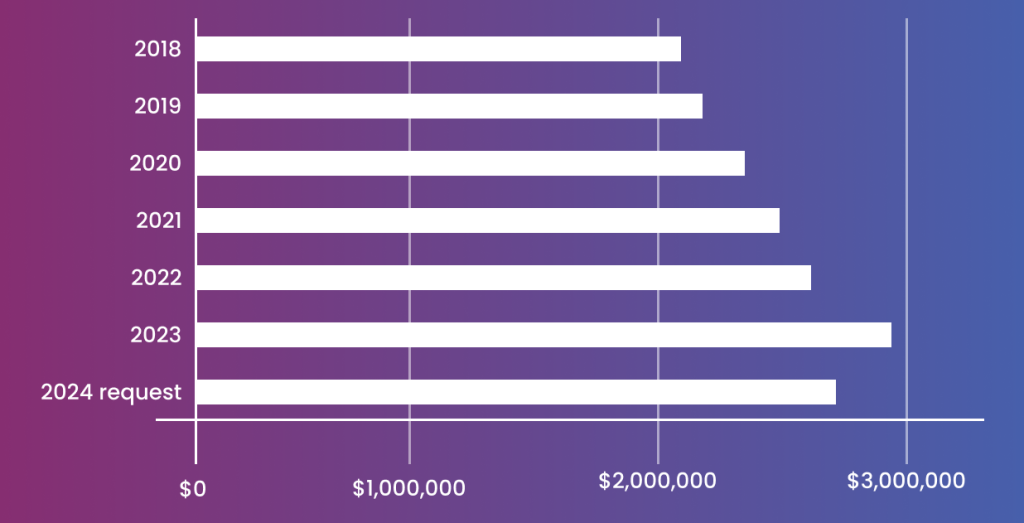
- Nearly two-thirds of businesses are spending over $2 million to cover the rising maintenance costs of their legacy systems.
After using an eCommerce platform for a long time, companies realize they have spent more on software maintenance than paid for actual software. To keep your system up and running, you spend a considerable amount to maintain the crucial components of legacy solutions. Eventually, the cost of solution maintenance rises significantly.
2. Lower Security Standards
Vendors of an outdated system stop supporting older versions, Hence, when companies encounter critical issues like security breaches, the platform provider won’t be able to provide proper assistance, which results in data loss.
In the case of data assault, data repair is almost impossible in obsolete systems. Legacy systems cannot match the latest security standards, so eventually, you end up operating a system where your data is at risk. Therefore, 50% of organizations consider modernizing legacy systems to increase security.
3. Compatibility Challenges
Due to unscalable and inflexible architecture, organizations experience several compatibility issues in outdated systems including:
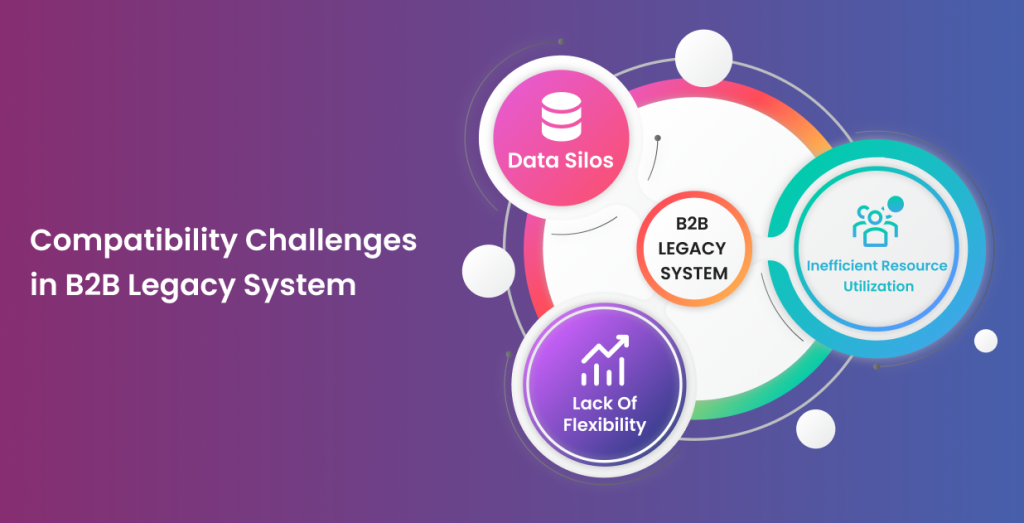
Data Silos:
When you migrate data from a legacy system to a modern platform, there are chances of data silo due to compatibility differences. Access to accurate and united data is essential to make effective business decisions and define customer-centric strategies.
You have to ask your team to ensure access to unified data. As a result, the employees lose 30% of their weekly hours chasing data.
Lack of Flexibility:
Legacy B2B eCommerce systems run with less flexibility. So, if you add new technology or advanced features, it’s a time-consuming process. Legacy systems have older configurations that are not compatible with modern features. So, after investing so much time and effort, there is no assurance that the new features will function effectively.
Inefficient Resource Utilization:
Due to all of the above challenges, the IT team needs to spend more time and resources on:
- Extracting Data From Varied Sources
- Migrating the Data to the Legacy Platform
- Ensuring Smooth Synchronization of all the Systems
With an inefficient outdated platform, all your team’s efforts are worthless.
4. Lack of Usability
Over time, outdated systems reduce the release of new versions. Consequently, it becomes difficult for your team to operate a system with an outdated user interface and functionality. Most employees waste time figuring out how these systems work and how to use them.
5. Losing Profitability
Finally, you need to check how legacy systems are profitable to your business. To determine this, you should get the answer to some questions that involve:
- Do These Systems Serve Their Original Purpose?
- What is the Purpose of Continuing Outdated Systems for Your Business?
- How Frequently Are You Using Them?
- Is There Any Change in the Actual Goal?
Legacy System Modernization – A Proven Approach to Overcome Challenges of B2B Legacy Systems
Though B2B organizations deal with critical challenges for using legacy systems that hamper their overall business efficiency, they are hesitant to adopt modernization. The most common excuses we come across are:
- Cost of Optimizing IT Ecosystem
- Investing Significant Time and Efforts
- The Staff is Comfortable with the Old Systems
Don’t allow such reasons to hold you back from gaining success!
Let ioVista, a leading B2B digital transformation agency help you overcome the challenges caused by obsolete systems.
We analyze the gap between the capabilities of your legacy systems and expectations from internal and external users. Based on the insights, we create a customized strategy for legacy system modernization.
Following a step-by-step process of legacy system modernization, we ensure an efficient upgrade of your system that streamlines your business operations, increases organizational productivity, and reduces operational costs.
Are you ready to modernize your outdated B2B legacy systems? Get in touch with our experts to get a personalized consultation for modernization.
Frequently Asked Questions
What is Legacy System Modernization?
Legacy system modernization refers to migrating, updating, re-platforming, and transforming outdated systems into a robust, scalable, and feature-rich environment. By updating your obsolete systems, you can meet changing business needs and the latest technology standards.
Under modernization, you can upgrade legacy systems, platforms, architecture, and infrastructure. Using the latest technologies and development practices, you can boost security, maintainability, and performance of your old platform.
What is the Problem with Legacy Systems?
Your legacy systems are developed using old technologies. Thus, they become incompatible with the latest technologies and business needs. It raises scenarios of operational inefficiencies.
For examples:
With an outdated UI of the obsolete system, it will be difficult for your team to find the required features and functionality that help accomplish their tasks quickly.
Moreover, legacy systems face challenges of a long loading time, a higher frequency of software lag, and more. This harms the operational efficiency of your business.
How Can You Integrate Data From Your Legacy System into the Upgraded One?
To integrate your data with the upgraded system, you can add a service layer on top of the obsolete B2B eCommerce systems. This service layer transforms, validates, and implements business logic to data before moving it to the modernized solution.
Mike Patel

Mike Patel is the Founder and CEO of ioVista, a leading digital commerce agency specializing in eCommerce solutions. With a strong background in business and technology, Mike Patel has been at the forefront of driving digital transformations for businesses. He has successfully navigated the ever-changing landscape of eCommerce, helping companies leverage the power of online platforms to grow their brand, increase revenues, and optimize their digital presence. Under his leadership, ioVista has become a trusted partner with major technology companies: Adobe/Magento, Google, BigCommerce, Shopify, and Yahoo. He is dedicated to staying ahead of industry trends, adopting cutting-edge technologies, and continuously improving strategies to provide clients with a competitive edge. Mike’s commitment to excellence and client satisfaction is evident in every project ioVista undertakes.
Popular Posts
-
 B2B, E-Commerce, Manufacturing, Migration, Web Development
Adobe Commerce Security Update APSB25-50: Key Highlights
Mike Patel
11 Jun 2025 -
 B2B, E-Commerce, Manufacturing, Migration, Web Development
B2B Excellence Starts with Adobe Commerce (Magento) - Not WooCommerce
Mike Patel
03 Jun 2025 -
 B2B, E-Commerce, Manufacturing, Migration, Web Development
AI and ML in B2B: A Vision for the Future of Commerce by 2025
Mike Patel
27 May 2025 -
 B2B, E-Commerce, Manufacturing, Migration, Web Development
20 Next-Gen B2B eCommerce Features that will Dominate in 2025
Mike Patel
20 May 2025 -
 B2B, E-Commerce, Manufacturing, Migration, Web Development
WooCommerce to BigCommerce Migration Fuels Your B2B eCommerce Growth
Mike Patel
06 May 2025 -
 B2B, E-Commerce, Manufacturing, Migration, Web Development
Adobe Commerce SaaS: How Will It Empower Your eCommerce Business?
Mike Patel
22 Apr 2025 -
 B2B, E-Commerce, Manufacturing, Migration, Web Development
Leverage ERP Integration to Scale Your B2B eCommerce Business in 2025
Mike Patel
15 Apr 2025 -
 B2B, E-Commerce, Manufacturing, Migration, Web Development
Adobe Commerce Security Update APSB25-26: All You Need to Know
Mike Patel
10 Apr 2025 -
 B2B, E-Commerce, Manufacturing, Migration, Web Development
Adobe Commerce 2.4.8 Release: Key Highlights
Mike Patel
10 Apr 2025 -
 B2B, E-Commerce, Manufacturing, Migration, Web Development
Why Scaling Business Should Migrate WooCommerce Stores to Shopify
Mike Patel
08 Apr 2025 -
 B2B, E-Commerce, Manufacturing, Migration, Web Development
Why Does Adobe Commerce (Magento) Lead the Way of B2B eCommerce
Mike Patel
18 Mar 2025 -
 B2B, E-Commerce, Manufacturing, Migration, Web Development
10 Key Drivers of Digital Transformation in B2B eCommerce for 2025
Mike Patel
04 Mar 2025 -
 B2B, E-Commerce, Manufacturing, Migration, Web Development
5 Leading eCommerce Platforms to Build Scalable B2B Customer Portals
Mike Patel
25 Feb 2025 -
 B2B, E-Commerce, Manufacturing, Migration, Web Development
Google Search Ranking Volatility: All You Need to Know
Mike Patel
18 Feb 2025 -
 B2B, E-Commerce, Manufacturing, Migration, Web Development
Adobe Commerce Security Update APSB25-08: All You Need to Know
Mike Patel
13 Feb 2025 -
 B2B, E-Commerce, Manufacturing, Migration, Web Development
7 Strategic Benefits of an Online B2B Customer Portal
Mike Patel
11 Feb 2025 -
 B2B, E-Commerce, Manufacturing, Migration, Web Development
What Makes a Great Online B2B Customer Portal? Top 10 Features to Know
Mike Patel
04 Feb 2025 -
 B2B, E-Commerce, Manufacturing, Migration, Web Development
Legacy B2B eCommerce Systems Slowing You Down? It's Time for Modernization
Mike Patel
28 Jan 2025 -
 B2B, E-Commerce, Manufacturing, Migration, Web Development
Essential B2B Commerce Features for 2024
Mike Patel
20 Nov 2024 -
 B2B, E-Commerce, Manufacturing, Migration, Web Development
Security Update Available for Adobe Commerce | APSB24-90
Mike Patel
20 Nov 2024 -
 B2B, E-Commerce, Manufacturing, Migration, Web Development
Why Choose Hyvä Enterprise for Your Adobe Commerce Store?
Mike Patel
19 Nov 2024 -
 B2B, E-Commerce, Manufacturing, Migration, Web Development
Security Update APSB24-73 for Adobe Commerce: Everything You Need to Know
Mike Patel
14 Oct 2024 -
 B2B, E-Commerce, Manufacturing, Migration, Web Development
CosmicSting Exploit Still Poses a Threat
Mike Patel
25 Jul 2024 -
 B2B, E-Commerce, Manufacturing, Migration, Web Development
CosmicSting: Unauthorized XXE Vulnerability
Mike Patel
17 Jul 2024 -
 B2B, E-Commerce, Manufacturing, Migration, Web Development
Hyvä Theme for Magento 2: Uncover Powerful Features – Evaluate Pros and Cons
Mike Patel
16 Jul 2024 -
 B2B, E-Commerce, Manufacturing, Migration, Web Development
Magento 2.4.7: Explore the Newest Enhancements and Features
Mike Patel
30 Apr 2024 -
 B2B, E-Commerce, Manufacturing, Migration, Web Development
Magento 2.4.6-p5: Enhancing Stability and Security
Mike Patel
22 Apr 2024 -
 B2B, E-Commerce, Manufacturing, Migration, Web Development
Everything You Need To Know About eCommerce SEO in 2024
Mike Patel
16 Apr 2024 -
 B2B, E-Commerce, Manufacturing, Migration, Web Development
The Impact of Site Speed on eCommerce SEO Performance
Mike Patel
14 Feb 2024 -
 B2B, E-Commerce, Manufacturing, Migration, Web Development
ioVista Attains B2B Specialization on BigCommerce
Mike Patel
30 Oct 2023 -
 B2B, E-Commerce, Manufacturing, Migration, Web Development
5 Ways to Boost eCommerce Sales in 2024
Mike Patel
21 Sep 2023 -
 B2B, E-Commerce, Manufacturing, Migration, Web Development
It’s Official: ioVista Has Become a Recognized Adobe Specialized Partner
Mike Patel
05 Sep 2023 -
 B2B, E-Commerce, Manufacturing, Migration, Web Development
Magento 2.4.7-beta1 Release
Mike Patel
15 Aug 2023 -
 B2B, E-Commerce, Manufacturing, Migration, Web Development
Why Are You Still Using Yahoo Stores in 2023?
Mike Patel
05 Jul 2023 -
 B2B, E-Commerce, Manufacturing, Migration, Web Development
ioVista Announced as a 2023 Local Excellence Award Winner by UpCity
Mike Patel
09 May 2023 -
 B2B, E-Commerce, Manufacturing, Migration, Web Development
Google Analytics 4: What You Need To Know
Mike Patel
29 Mar 2023 -
 B2B, E-Commerce, Manufacturing, Migration, Web Development
Adobe Commerce 2.4.6 Release
Mike Patel
13 Mar 2023 -
 B2B, E-Commerce, Manufacturing, Migration, Web Development
Questions You Should Ask Your Magento Agency
Mike Patel
17 Feb 2023 -
 B2B, E-Commerce, Manufacturing, Migration, Web Development
7 Proven Strategies to Increase B2B/Wholesale eCommerce Revenue
Mike Patel
01 Feb 2023 -
 B2B, E-Commerce, Manufacturing, Migration, Web Development
10 eCommerce Trends to Increase your Sales in 2023
Mike Patel
12 Jan 2023 -
 B2B, E-Commerce, Manufacturing, Migration, Web Development
B2B eCommerce Features Your Store Need in 2023
Mike Patel
05 Jan 2023 -
 B2B, E-Commerce, Manufacturing, Migration, Web Development
Adobe/Magento Highlights 2022 - Is your store Up-to-Date
Mike Patel
20 Dec 2022 -
 B2B, E-Commerce, Manufacturing, Migration, Web Development
BigCommerce Releases StagingPro for Enterprise Merchants and Agency Developers
Mike Patel
15 Dec 2022 -
 B2B, E-Commerce, Manufacturing, Migration, Web Development
Adobe discontinues Support for the 2.4.0-2.4.3 Release Line
Mike Patel
09 Dec 2022 -
 B2B, E-Commerce, Manufacturing, Migration, Web Development
BFCM Round-Up – Get Your Store Ready for Christmas 2022!
Mike Patel
07 Dec 2022 -
 B2B, E-Commerce, Manufacturing, Migration, Web Development
Universal Analytics Going Away: What Does it Mean, What you need to Do?
Mike Patel
24 Nov 2022 -
 B2B, E-Commerce, Manufacturing, Migration, Web Development
40% of Magento and Adobe Commerce Websites at Risk in November 2022
Mike Patel
17 Nov 2022 -
 B2B, E-Commerce, Manufacturing, Migration, Web Development
ioVista Awarded the Best B2B Company 2022
Mike Patel
04 Nov 2022 -
 B2B, E-Commerce, Manufacturing, Migration, Web Development
Adobe Releases Critical Security Patches for Magento 2.4.5 and 2.4.4
Mike Patel
27 Oct 2022 -
 B2B, E-Commerce, Manufacturing, Migration, Web Development
Holiday Season Best Practices for eCommerce
Mike Patel
20 Oct 2022 -
 B2B, E-Commerce, Manufacturing, Migration, Web Development
ioVista is Sponsoring the Largest eCommerce Event in Dallas
Mike Patel
07 Oct 2022 -
 B2B, E-Commerce, Manufacturing, Migration, Web Development
Magento 2 Vulnerability: Surge in Hacking on Unpatched Stores
Mike Patel
27 Sep 2022 -
 B2B, E-Commerce, Manufacturing, Migration, Web Development
Get your Holiday eCommerce Marketing Started with These 5 Tips
Mike Patel
15 Sep 2022 -
 B2B, E-Commerce, Manufacturing, Migration, Web Development
Why a Magento Code Audit is Essential for your eCommerce Store
Mike Patel
10 Sep 2022 -
 B2B, E-Commerce, Manufacturing, Migration, Web Development
Launching a Successful eCommerce Store
Mike Patel
30 Aug 2022 -
 B2B, E-Commerce, Manufacturing, Migration, Web Development
Choosing the Right eCommerce Platform for B2B
Mike Patel
25 Aug 2022 -
 B2B, E-Commerce, Manufacturing, Migration, Web Development
The Challenges of eCommerce in Manufacturing and how to Overcome them
Mike Patel
17 Aug 2022 -
 B2B, E-Commerce, Manufacturing, Migration, Web Development
Adobe Releases Magento Open Source and Adobe Commerce 2.4.5
Mike Patel
10 Aug 2022 -
 B2B, E-Commerce, Manufacturing, Migration, Web Development
How Manufacturers can Switch to eCommerce
Mike Patel
02 Aug 2022 -
 B2B, E-Commerce, Manufacturing, Migration, Web Development
Benefits of eCommerce for Manufacturing
Mike Patel
25 Jul 2022 -
 B2B, E-Commerce, Manufacturing, Migration, Web Development
Magento 2.3.x End-of-Life in September 2022
Mike Patel
19 Jul 2022 -
 B2B, E-Commerce, Manufacturing, Migration, Web Development
The Growth of eCommerce and its impact on the Manufacturing Industry
Mike Patel
01 Jul 2022 -
 B2B, E-Commerce, Manufacturing, Migration, Web Development
The Future of Manufacturing Business is Digital
Mike Patel
24 Jun 2022 -
 B2B, E-Commerce, Manufacturing, Migration, Web Development
Magento Open Source Vs Commerce Vs Cloud: How to Pick your Edition
Mike Patel
14 Jun 2022 -
 B2B, E-Commerce, Manufacturing, Migration, Web Development
Is your Store Optimized? How do you Measure eCommerce Conversion Rates?
Mike Patel
11 May 2022 -
 B2B, E-Commerce, Manufacturing, Migration, Web Development
ioVista Recognized for B2B Services: Excellence Award Winner 2022
Mike Patel
03 May 2022 -
 B2B, E-Commerce, Manufacturing, Migration, Web Development
How to Optimize Your eCommerce Store for Conversions
Mike Patel
29 Apr 2022 -
 B2B, E-Commerce, Manufacturing, Migration, Web Development
Future Proof your Digital Commerce with Headless Commerce
Mike Patel
21 Apr 2022 -
 B2B, E-Commerce, Manufacturing, Migration, Web Development
Adobe Commerce 2.4.4 Release: Faster, Better, More Scalable
Mike Patel
13 Apr 2022 -
 B2B, E-Commerce, Manufacturing, Migration, Web Development
Adobe Commerce and Magento 1 Sites at Risk: Magento Vulnerabilities Exploited
Mike Patel
29 Mar 2022 -
 B2B, E-Commerce, Manufacturing, Migration, Web Development
Is Your Business Ready for Digital Transformation? The Key Steps!
Mike Patel
01 Mar 2022 -
 B2B, E-Commerce, Manufacturing, Migration, Web Development
CVE-2022-24086 What is it?
Mike Patel
16 Feb 2022 -
 B2B, E-Commerce, Manufacturing, Migration, Web Development
February 2022, over 500 Legacy Magento 1 Websites Hacked!
Mike Patel
15 Feb 2022 -
 B2B, E-Commerce, Manufacturing, Migration, Web Development
Adobe released a new End of Support Date for Magento 2.3.x
Mike Patel
04 Feb 2022 -
 B2B, E-Commerce, Manufacturing, Migration, Web Development
The How & Why: Successful Data-Driven Marketing for eCommerce Stores
Mike Patel
13 Jan 2022 -
 B2B, E-Commerce, Manufacturing, Migration, Web Development
How to Find Right Audience for your Online Business
Mike Patel
10 Jan 2022 -
 B2B, E-Commerce, Manufacturing, Migration, Web Development
5 Key Reasons to Enable Social Commerce Channels for your Store
Mike Patel
17 Dec 2021 -
 B2B, E-Commerce, Manufacturing, Migration, Web Development
ioVista is honored to be one of the Top 1000 Companies 2021
Mike Patel
13 Dec 2021 -
 B2B, E-Commerce, Manufacturing, Migration, Web Development
Are Your FB, Instagram, Pinterest Accounts Geared for Social Shopping?
Mike Patel
30 Nov 2021 -
 B2B, E-Commerce, Manufacturing, Migration, Web Development
Five BFCM Strategies Merchants Love To Implement For Holidays
Mike Patel
26 Oct 2021 -
 B2B, E-Commerce, Manufacturing, Migration, Web Development
How to Meet Holiday Shoppers’ Needs With an Omnichannel Approach
Mike Patel
20 Oct 2021 -
 B2B, E-Commerce, Manufacturing, Migration, Web Development
Support for Magento Commerce 2.3 and Magento Open Source 2.3 Ends
Mike Patel
05 Oct 2021 -
 B2B, E-Commerce, Manufacturing, Migration, Web Development
Why your Business Needs Marketing Automation this Holiday Season
Mike Patel
30 Sep 2021 -
 B2B, E-Commerce, Manufacturing, Migration, Web Development
How Augmented Reality can Deliver more Engaging Shopping Experiences
Mike Patel
21 Sep 2021 -
 B2B, E-Commerce, Manufacturing, Migration, Web Development
These 5 Local Business Marketing Strategies Will Transform Your Business
Mike Patel
17 Sep 2021 -
 B2B, E-Commerce, Manufacturing, Migration, Web Development
How eCommerce can be the Game Changer for Warehouses
Mike Patel
08 Sep 2021 -
 B2B, E-Commerce, Manufacturing, Migration, Web Development
Magento 2.4.3 has arrived! Everything you Need to Know
Mike Patel
11 Aug 2021 -
 B2B, E-Commerce, Manufacturing, Migration, Web Development
ioVista named 2021 Top B2B Company in Dallas and Texas
Mike Patel
05 Aug 2021 -
 B2B, E-Commerce, Manufacturing, Migration, Web Development
Why Every Business Should Be on eCommerce
Mike Patel
29 Jul 2021







Let’s work together to create outstanding digital experiences.
With 20+ years of industry experience, ioVista understands your eCommerce needs and delivers best-in-class solutions that help you gain a competitive edge.
or Call us at: +1 214-699-4391

TOP
Get in Touch